Your sales deck doesn't need better slides. It needs a better story.
Most B2B decks fail because there's no narrative holding them together — not because the design is wrong.
I find the story your buyers need to hear, then build the deck and one-pagers that make it land.
When product, marketing, and sales finally tell the same story — in the same order — deals stop dying to "we'll circle back."





Your product works.
But your narrative doesn’t - and it’s costing you deals
Your product is solid. Your story? Kind of a mess.
Everyone on your team tells a different story - so your buyer hears none.
Marketing leads with whatever they wish buyers cared about. Sales rewrites everything because "this won't land in a real convo." Product insists on language no buyer has ever said out loud.
Real cost: Your narrative falls apart the moment the zoom call ends. Copy edit won’t fix it - there was never a coherent narrative to begin with.
Your assets aren’t the problem. The disconnect is.
The deck crushed it in the launch meeting. Two weeks later, reps stopped using it.
Not because the design is bad. Because it doesn't match how buyers actually think or decide. So reps hack together their own version — or wing it and hope.
They're not rejecting the design. They're rejecting a deck that doesn't tell the story that buyers need to hear.
Real cost: You’re producing content no one trusts, and everyone ignores.
Deals stall because champions can't sell you internally
Your champion loves the one-pager. The CFO, CTO, and VP of Ops aren't buying it.
So your champion walks into internal meetings without a story anyone else understands — and you're not in the room to help. The dots don't connect. The deal stalls.
Real cost: Multi-threading collapses and deals die quietly because you never gave them a narrative anyone else could follow.
Won deals involve an average of 17 buyers. Lost deals? Five.
51% of B2B deals are lost to status quo — not to competitors.
Your biggest competitive threat isn't who you think. It's your buyer deciding to do nothing.
— Gong, 1M executive sales cycles, 2026
Here's what's actually happening
Sales assets that don’t land are a symptom, not the problem.
Sales doesn't believe them because there's no narrative underneath them. Not a positioning statement — a narrative. The story your buyer needs to hear, in the order they need to hear it, so by the time you get to the ask, the answer feels obvious.
Most companies skip that. They jump to slides, copy, and design — then wonder why nothing sticks.
Your champion isn't buying alone.
They have to sell you inside their company — to Finance, Ops, Engineering — without you in the room.
A list of features and benefits won't get them through that. Deals move when your champion can resell your story clearly. Deals stall when they can't.
Your assets need to make their internal sell easy — or the deal dies.
I find the narrative your team can't see from the inside. I've sat inside enough deals, across enough companies, to know exactly where the story breaks and why reps stop trusting the assets. Your team is too close to it. Your reps won't say it out loud — not to you.
Someone who's done this across dozens of companies can get you there in weeks. You spend the rest of the year watching what happens when the whole team finally has one narrative — and it works.
I start with the narrative.
the assets is where they come to life.
“Talya is quite literally lightening in a bottle. She made an almost immediate impact.”

“Our space is very active and changes constantly. She helped us find white space and ways that we could stand out in the crowd”

“An amazing partner in refining our product and competitive positioning. Sales identified the deck as the critical missing gap. Her organization and ability to get up to speed on the unique market is unmatched, not to mention, she’s just a joy to interact and collaborate with”

Here’s how it works
Step 1: diagnosis
I don't need seven workshops. Three honest conversations with your SMEs and a look at what you're currently doing tells me where the narrative breaks and why your team doesn’t agree on the story.
What you get:
Understanding of what really closes deals
Clarity on where alignment breaks between teams
Immediate "oh Shoot, THAT's why" moments
Step 2: Build The Win Map™—your source of truth
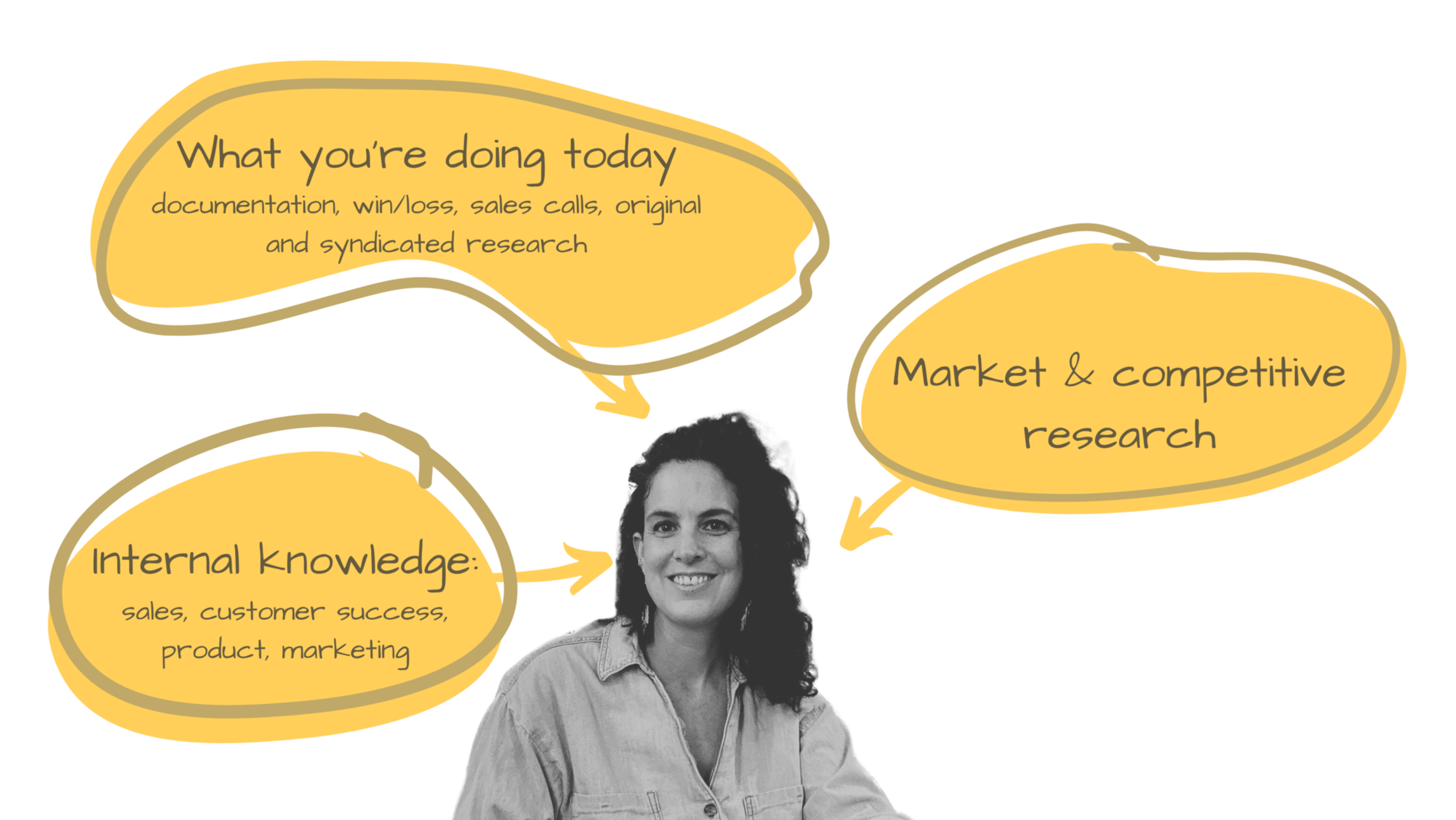
I don't just hand you a positioning statement and wish you luck. I build The Win Map™— the narrative arc that drives your deck, one pagers, and any other asset your team produces - from outreach to website copy.
It’s not a doc; it connects market research, persona insights, competitive positioning to your product and proof. It’s the story your company tells - structured so product, marketing and sales are finally speaking the same language.
Simple enough that reps use it on Monday. Structured enough to feed directly into your AI stack.
What you get:
One narrative your whole GTM team agrees on. Not a statement, a story
Messaging that holds up when buyers push back and when reps go off-script
Competitive narrative that doesn’t just say you’re different, it makes your “different” matter
Positioning that product, marketing, and sales believe in because they see themselves in it
Use as-is or feed to your AI stack directly — no reformatting required
83% of winning vendors actively helped buyers navigate their buying committee. The narrative isn't optional — it's what separates deals that close from deals that stall. Buyer Truths 2026, 172 B2B software buyers
Step 3: Sales enablement that survives the field
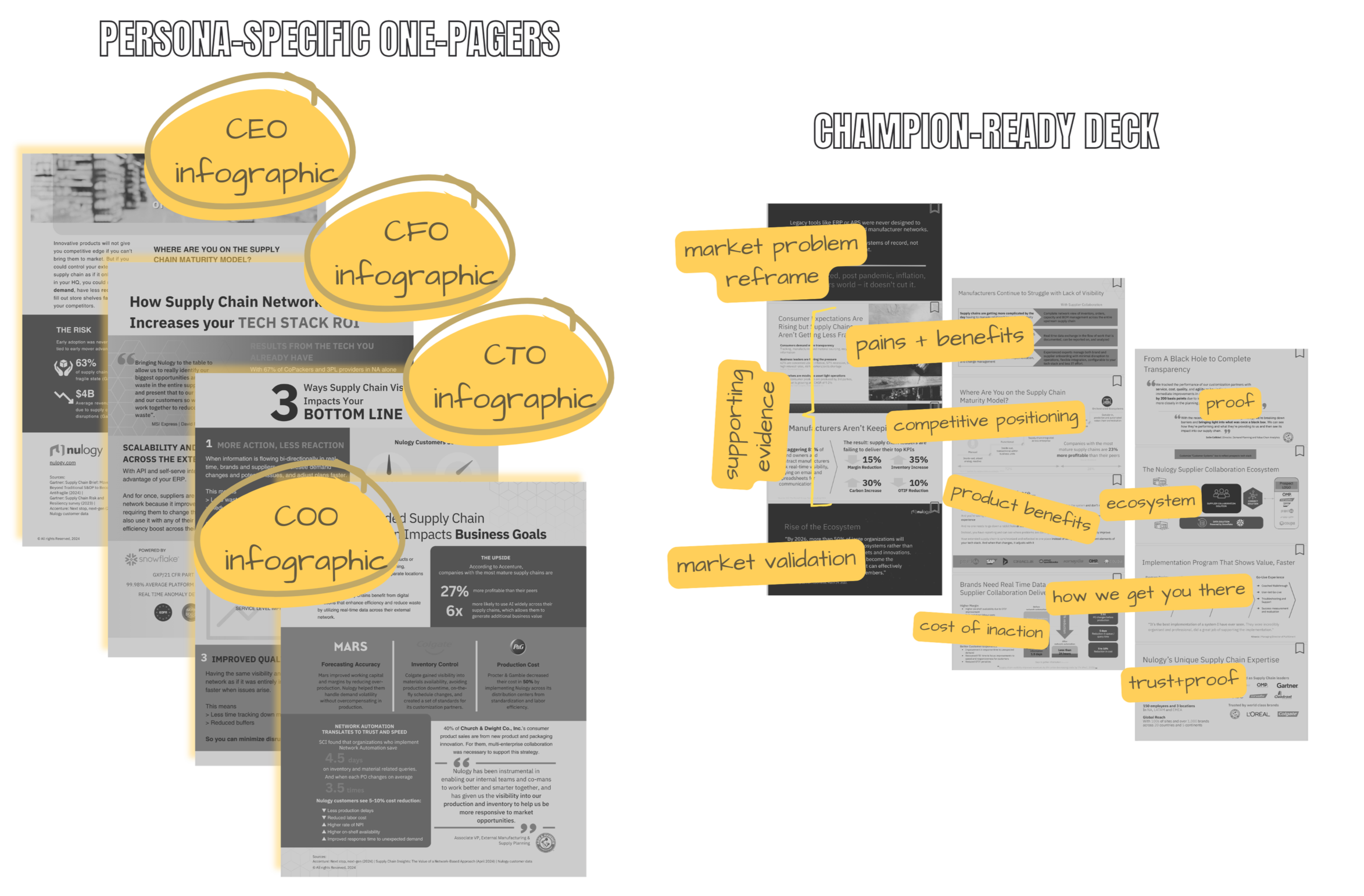
Your assets work because they're built on the narrative — not assumptions, last week’s opinions or what the brand agency suggested. Sales trusts them. Champions can retell them. Deals close faster.
What you get:
Executive one-pagers for the invisible people in the buying team
Sales deck reps have conviction on
All connected back to your Notion clarity system
Pricing
Most full engagements run $30–45K depending on scope, research depth, and number of assets. Advisory starts at $2,500/month for teams that need strategic guidance while they execute internally.
The right scope depends on what's actually broken and how much bandwidth your team has to execute. After our diagnostic call, I'll recommend what fits based on:
- Whether you need the system built or strategic guidance while your team executes
- Number of products, use cases, or personas
- Complexity of your competitive landscape
Not sure if the investment makes sense for you? RUN YOUR NUMBERS FIRST →
frequently asked questions
-
Positioning is like your mission statement. Narrative positioning makes it practical.
Most positioning work ends with a statement. Mine ends with a story that drives your deck, your one-pagers, and every asset your champion uses to sell you internally. It tells your buyers why the should care in the order that makes them act, making any asset creation - whether it’s a new webpage or outreach, easier for your team to pull off while staying true to your story.
-
The problem usually isn't the slides — I’ve seen basic slides that work well and gorgeous ones that don’t.
When there's no coherent narrative holding the deck together, reps don't trust it and buyers don't remember it. A deck built on narrative positioning tells a story that builds to a conclusion. A deck without it is just a collection of good-looking slides that don't add up.
-
A champion deck is built for internal selling — not for your first sales call. It gives your champion the story, language, and evidence they need to convince Finance, Ops, Engineering, and anyone else in the buying committee. 83% of winning vendors help buyers navigate their buying committee. A champion deck is how.
-
April Dunford's framework is excellent for defining your competitive positioning — what you are and why you win. Fletch is great for homepage-first positioning. I build the narrative layer that turns positioning into assets that actually get used in sales conversations. If you've done positioning work but your deck still isn't landing, the missing piece is usually the narrative.
In addition, my approach is not through workshops. A sticky narrative can’t be based on the loudest person’s opinions, it needs to be based on facts. I build it with that approach. -
The Win Map™ connects market research, buyer insights, competitive positioning, and messaging into one narrative system. It's built in Notion so your entire team can access it. From there, I build the assets — all connected to the same narrative foundation.
If you wish to maintain it in a different way, it’s completely exportable, including to a markdown file.
-
Yes. Part of why the assets stick is that I talk to your reps, not just your marketing team. They know what actually lands in buyer conversations. That input shapes the narrative — and when reps see their reality reflected in the assets, they use them.
-
Projects depend on scope and complexity. A full Win Map™ system and asset creation usually takes between 4-12 weeks, depending on portfolio size and the the number of assets needed.
-
Yes. Some clients start with Advisory to test fit, then move to a larger project when they realize the problem is bigger than they thought.
-
Former Fletch clients can work with me just for assets, and in any advising capacity.
Assets
As long as the positioning Fletch PMM provided you is still relevant, I can work with their framework for asset creation. Note this process is entirely different, and does not include the Win Map™ system or further positioning work.
If you’re interested, book a call and we can discuss the details.



FEATURED ON